Boswellia frereana · Somalia
Maydi
The King of Frankincense.
Boswellia frereana is one of frankincense’s most distinctive species. Known in Somalia as Maydi, it grows on the limestone escarpments of northern Somalia, produces one of the world’s most prized frankincense resins, and possesses a chemistry distinct from the other Boswellia species found elsewhere.
For thousands of years, frankincense from the Somali coast travelled into Egypt, Arabia, China and the wider world. Today, modern science is examining what makes Boswellia frereana so distinctive.
Pure resin. Somali origin. Nothing added.

Boswellia frereana · Somali Maydi · 50 ml · traditionally chewed as well as burned · distinctive chemistry · 299 kr / €29.

One species. One place.
Boswellia frereana is endemic to northern Somalia. It grows among steep limestone cliffs and rocky escarpments, where mature trees anchor themselves directly into cracks in the stone. The resin is known locally as Maydi. It comes from a remarkably restricted geographic range, and it is a distinct Boswellia species with a chemical profile of its own.
Every Boswellia species has its own chemistry. Maydi has a signature of its own.
Modern chemical analysis has shown that Boswellia frereana has a distinctive chemical fingerprint. Research on individual trees found a triterpenoid fraction rich in lupeol, α-amyrin, 3-epi-lupeol and β-amyrin, alongside a characteristic volatile profile led by α-thujene and α-pinene.
- Lupeol
- α-Amyrin
- 3-epi-Lupeol
- β-Amyrin

From the Land of Punt
Ancient Egypt’s relationship with frankincense reaches back thousands of years. Egyptian expeditions travelled to Punt, the frankincense-producing lands of the Horn of Africa centred on the Somali region. Queen Hatshepsut’s famous expedition, depicted at Deir el-Bahari, returned with incense trees themselves. Northern Somalia remains the natural home of Boswellia frereana, and the frankincense trade of the Somali coast is documented across thousands of years.
Convergence
Across civilizations, the record keeps returning to frankincense — and Maydi has a documented lineage of its own.
Ancient Egypt, the Jewish tradition, Coptic Christianity, the Arabian and Islamic world, and China each left a record of frankincense — in ritual, oral use, medicine and trade. In several of those branches the trail leads specifically to the Somali resin known as Maydi, and later botany identifies that resin as Boswellia frereana.
Northern Somalia
MAYDI
Boswellia frereana
“The King of Frankincense”
Wider Boswellia traditions — Ayurveda / India
The classical Indian Boswellia tradition centres primarily on Boswellia serrata. It provides wider context for the global Boswellia tradition, while Maydi's documented lineage is rooted in northern Somalia.
Maydi — Boswellia frereana, northern Somalia
Kew records Boswellia frereana as an accepted species native to northern and north-eastern Somalia, its resin known as maidi or meydi, used as frankincense and chewed, and a major export commodity. Bangor University describes it as often called the king of frankincense, growing naturally only in Somalia. CITES notes it is internationally considered the most expensive type of frankincense.
Northern Somalia
MAYDI
Boswellia frereana
“The King of Frankincense”
Why “King”? Sources
Kew records Boswellia frereana as an accepted species native to northern and north-eastern Somalia, its resin known as maidi or meydi, used as frankincense and chewed, and a major export commodity. Bangor University describes it as often called the king of frankincense, growing naturally only in Somalia. CITES notes it is internationally considered the most expensive type of frankincense.
Ancient Egypt / Punt
Punt expeditions · Hatshepsut relief
Sources
Egyptian expeditions to Punt returned with incense and incense trees, recorded in relief at Deir el-Bahari. Scholarship locating Punt on the Somali coast notes that this coast produces premium resin from Boswellia frereana.
- Egyptian record: Punt supplies frankincense; Hatshepsut relief shows incense trees carried to Egypt
- Egyptological identification: Punt placed on the Somali coast
- Botany: that coast is the natural range of Boswellia frereana — Maydi
Jewish tradition
Levonah in the Ketoret
Sources
Frankincense is levonah, named in Exodus 30:34 among the components of the sacred incense, with the phrase levonah zakah — pure frankincense. The Encyclopaedia Judaica frankincense entry explicitly lists Boswellia frereana of North Somalia among the Boswellia species from which frankincense is extracted.
Coptic Christianity
Maydi · “Coptic frankincense”
Sources
The CITES species assessment records that Boswellia frereana is known as maydi or meydi in Somalia and as Coptic frankincense in Europe, and that it is prized as incense in the Coptic Church of Egypt. A scholarly chapter on ancient spices records the same species/church association. This is a direct, species-level cultural identification.
Arabia & Islamic world
Maydi · Luban lami · chewing tradition
Sources
Thulin records Boswellia frereana as restricted to northern Somalia, its resin called maidi or meydi in Somali and luban meiti or luban lami in Arabic, chewed above all, with Saudi Arabia and other Middle Eastern countries as the chief consumers. CITES adds that Saudi Arabia is the largest importer and that the chewing grades matter at weddings, religious festivals and during Hajj.
China
Ming voyages · Somali frankincense · modern Maydi trade
Sources
Fifteenth-century Chinese records name Mogadishu and Brava as frankincense-producing and frankincense-trading ports. A modern official Puntland plan separately records Chinese trade agreements covering Maydi and Beeyo, and Kew identifies Maydi as Boswellia frereana. Modern Chinese scientific literature studies Boswellia frereana explicitly.
- Ming record: Fei Xin’s Mogadishu entry states 地产乳香 — the land produces frankincense
- Ming History: Brava and neighbouring Somali ports listed with frankincense among their products
- Official Puntland plan: Chinese trade agreements covering both Maydi and Beeyo
- Kew: Maydi = Boswellia frereana
- Modern Chinese scholarship studies Boswellia frereana by name
Modern science
Species-specific chemistry and models
Sources
Boswellia frereana is studied as a distinct species with its own chemistry and research literature. Bangor University describes it as often called the king of frankincense, growing naturally only in Somalia.
Wider Boswellia traditions — Ayurveda / India
The classical Indian Boswellia tradition centres primarily on Boswellia serrata. It provides wider context for the global Boswellia tradition, while Maydi's documented lineage is rooted in northern Somalia.
Frankincense recurs across civilizations, and the Somali coast recurs with it.
Then modern science began looking closer.
Modern science arrived much later. Researchers began separating Maydi’s molecules, comparing Boswellia species and testing its extracts and constituents in laboratory models. What emerged was a distinctive Boswellia frereana profile centred on lupeol, 3-epi-lupeol, α-amyrin, β-amyrin and its characteristic volatile chemistry.
Dedicated studies have examined cartilage and inflammatory signalling, HGF/c-Met-mediated cell migration and invasion, and the chemistry of the resin itself. Independent constituent research has also examined α-pinene and the amyrins in GABAergic and anxiolytic-like models.
Today, the same material can still be held in the hand.Shop Maydi →

The resin itself.
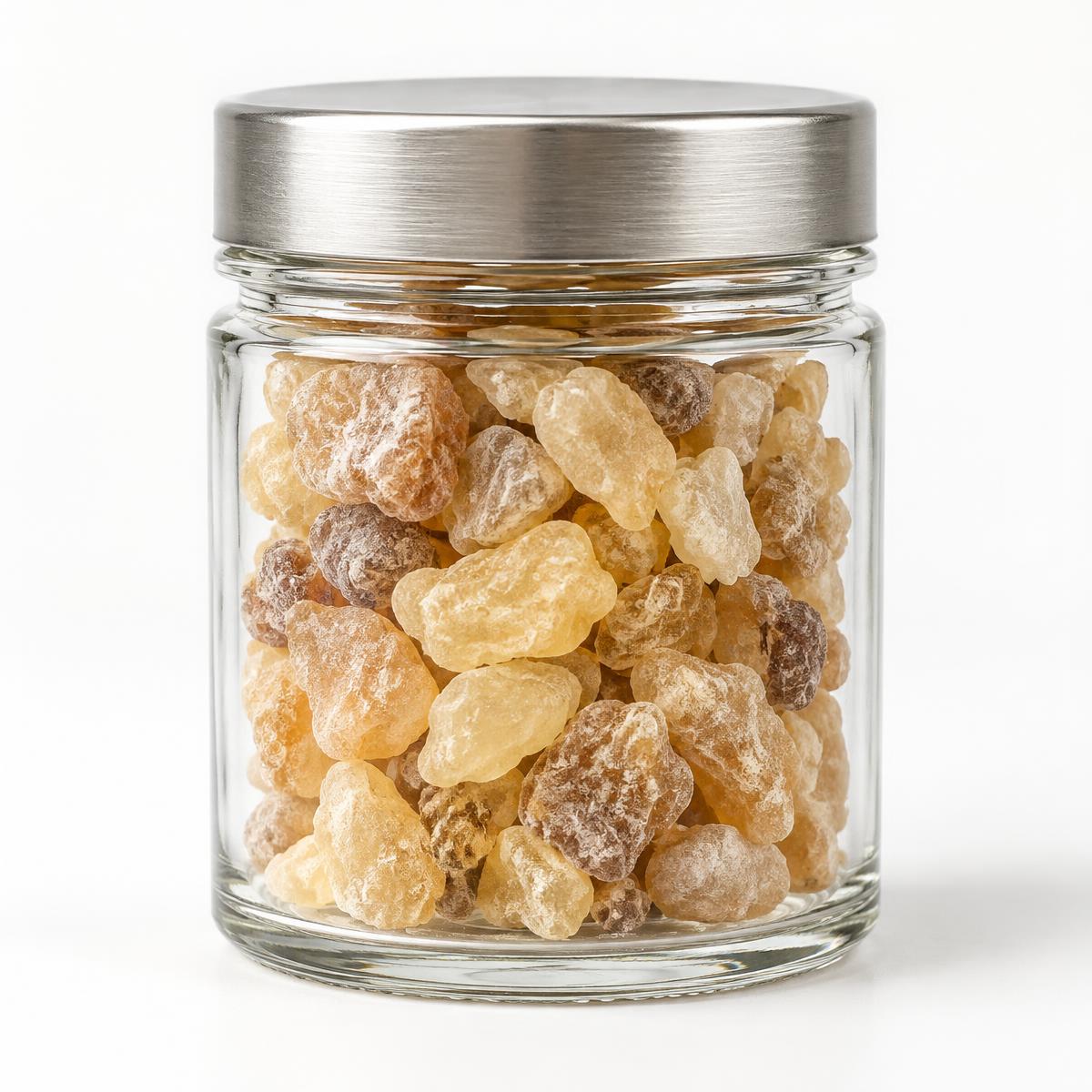
Natural Maydi varies. One jar may contain pale cream, golden, amber and light-brown pieces. Shapes range from small fragments to larger irregular pieces. Each jar preserves the resin’s natural variation in colour, shape and texture.
What you receive
Boswellia frereana resin · 50 ml glass jar · silver screw lid · no decorative front label · no added fragrance · no fillers.
299 kr / €29
Maydi. Boswellia frereana from Somalia.